PROMs, governance and Value in Healthcare: what the CESE congress is really telling us
From data-driven management to transforming care pathways: lessons, tensions and outlook The congress held at the Economic, Social and Environmental Council (CESE) on PROMs and Value-Based Healthcare (VBHC) brought together, over one packed day, clinicians, researchers, policymakers, health economists, industry players and institutional representatives. It offered a rich programme, built around a clear ambition…

From data-driven management to transforming care pathways: lessons, tensions and outlook
The congress held at the Economic, Social and Environmental Council (CESE) on PROMs and Value-Based Healthcare (VBHC) brought together, over one packed day, clinicians, researchers, policymakers, health economists, industry players and institutional representatives. It offered a rich programme, built around a clear ambition: to make patient-reported outcomes a central lever for transforming the health system.
Beyond the diversity of profiles and expertise, one conclusion stands out: VBHC has now reached conceptual maturity, but scaling it up operationally remains an open, complex and deeply systemic undertaking.
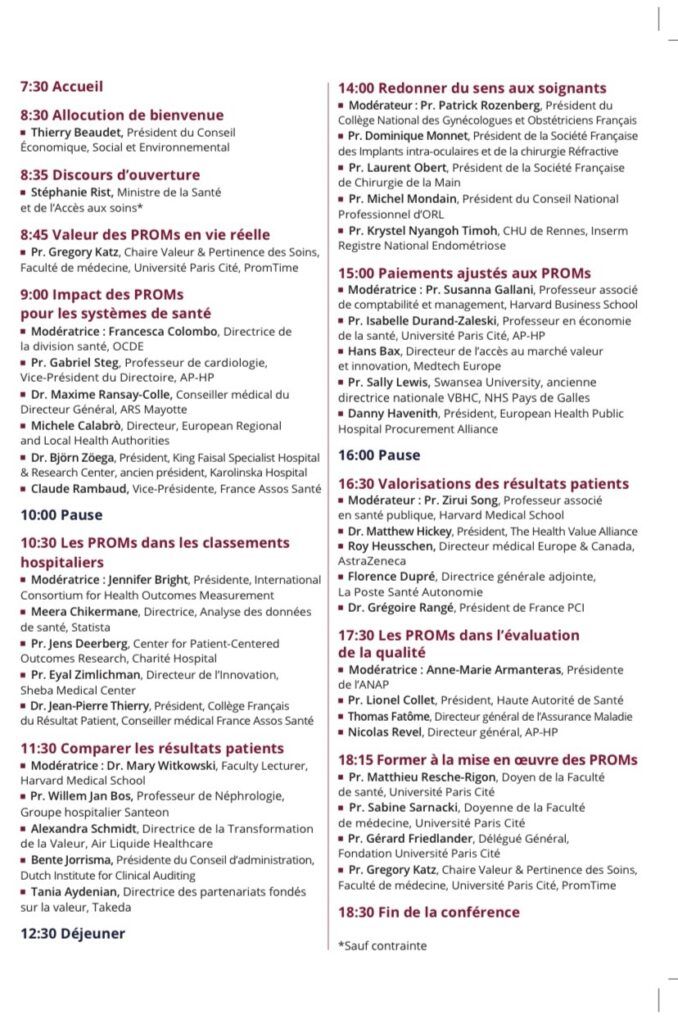
An opening focused on meaning
The welcome address by Thierry Beaudet, President of the Economic, Social and Environmental Council, underlined the need to put meaning, quality and lived experience back at the heart of public health policy.
From this introduction, the tone was set: it is no longer simply a matter of measuring, but of fundamentally rethinking the way we conceive of performance in healthcare.
The value of PROMs in real life: between potential and complexity
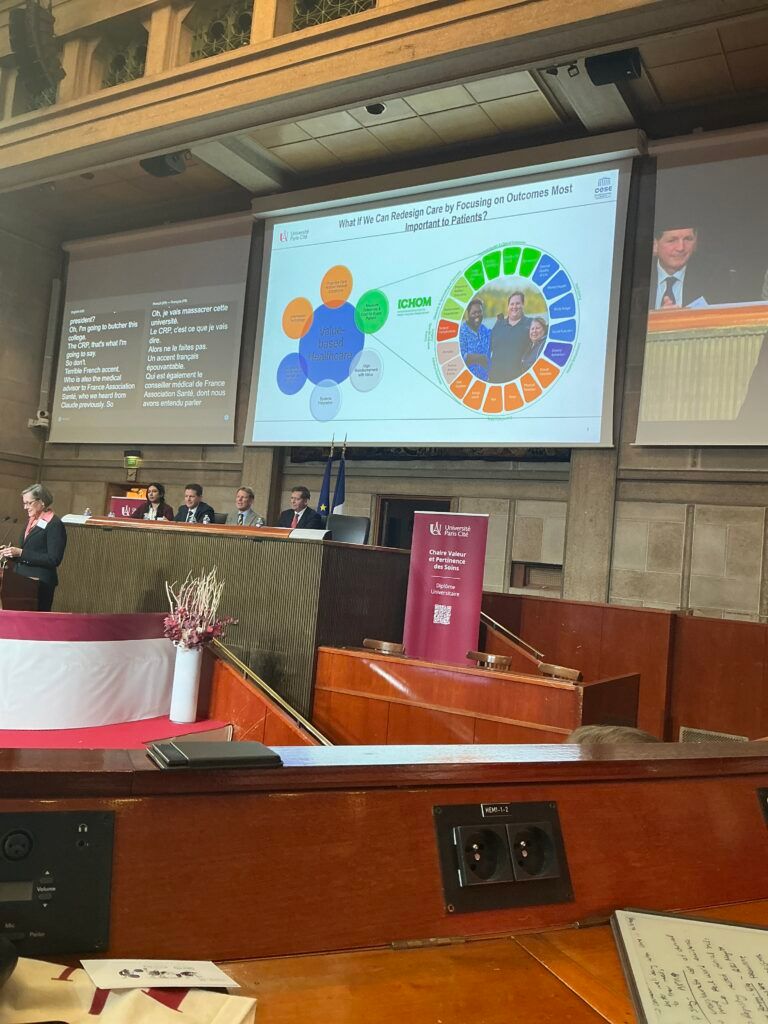
The first session, led by Prof. Gregory Katz (Chair of Value & Appropriateness of Care, Université Paris Cité, PromTime), laid down the scientific and clinical foundations of PROMs. Their contribution is now widely recognised: a better understanding of the patient's lived experience, more individualised treatment decisions, and quality management based on truly relevant criteria.
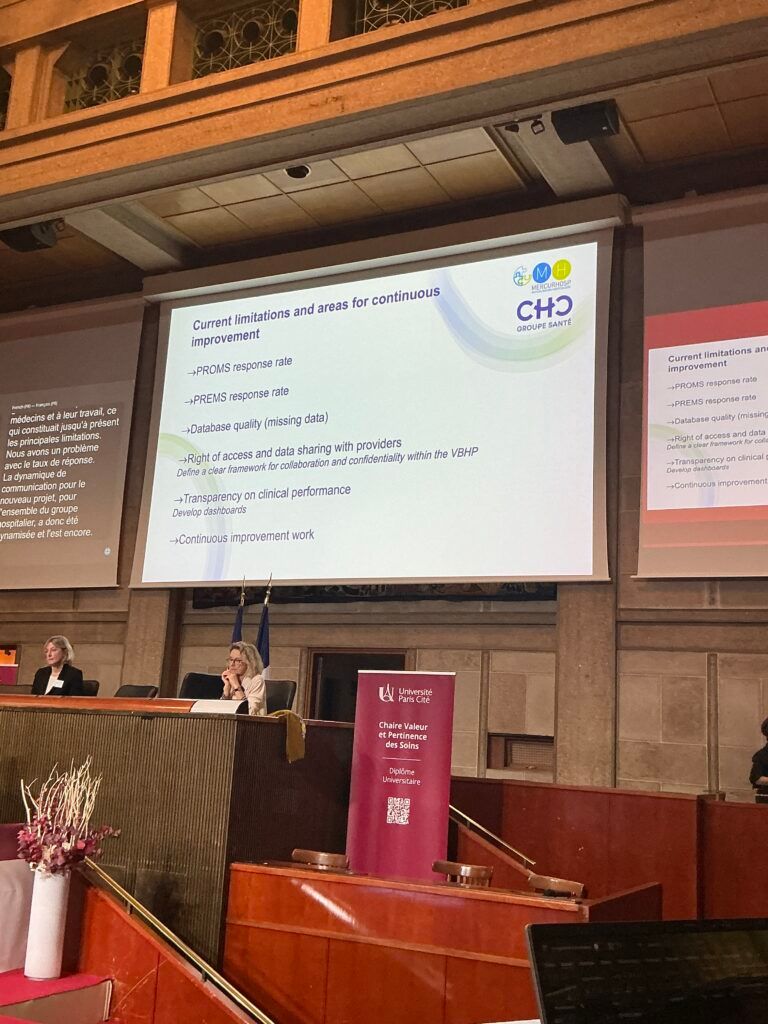
But several speakers pointed out the practical challenges of implementing them:
- Dr Jens Deerberg (Center for Patient-Centered Outcomes Research, Charité Hospital) stressed that, in many hospitals, PROMs reporting remains essentially internal, rarely shared, and still seldom integrated into clinical decision-making.
- Prof. Eyal Zimlichman (Director of Innovation, Sheba Medical Center) emphasised how difficult it is to move from data collection to genuine shared decision making, which is often more demanding than benchmarking itself.
The barriers are many: questionnaire fatigue for patients, information overload for healthcare professionals, complex integration into information systems, uncertainty about how the data will actually be used. Several levers nevertheless emerge as fundamental:
- engaging the patient early, from the very first consultation,
- feeding results back directly during the consultation,
- linking PROMs and CROMs,
- and above all, closing the improvement loop: collection → analysis → action → improvement → publication.
Systemic impact: when PROMs become a tool for transformation
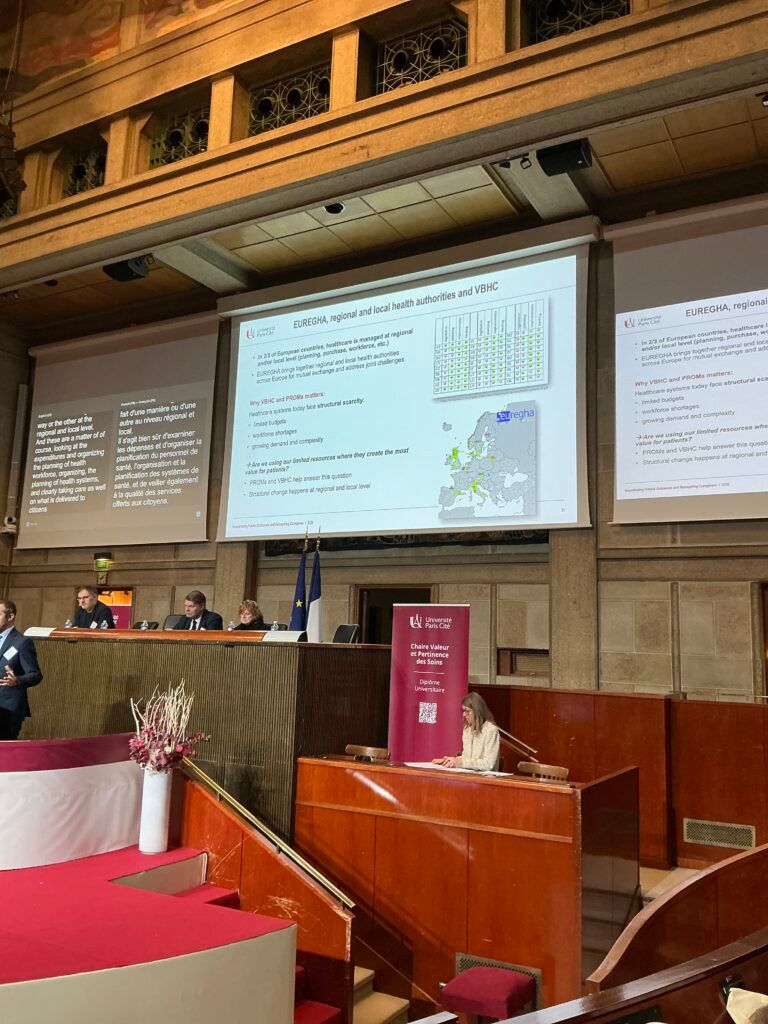
The session chaired by Francesca Colombo (Head of the Health Division, OECD) placed PROMs in a macro-systemic perspective. Alongside Prof. Gabriel Steg (AP-HP), Dr Maxime Ramsay-Colle (ARS Mayotte), Michele Calabrò (European Regional and Local Health Authorities), Dr Björn Zoëga (King Faisal Specialist Hospital & Research Center, former president of Karolinska Hospital) and Claude Rambaud (France Assos Santé), the discussions highlighted a fundamental point:
PROMs are not just a clinical tool, but a lever for organisational and political transformation.
The Swedish experience is particularly illuminating: participation in national registries partly determines funding, which creates a strong collective drive around quality, while raising major issues of governance and equity.
Hospital rankings and benchmarking: transparency or tension?
The round table on PROMs in hospital rankings, moderated by Jennifer Bright (ICHOM), with Meera Chikermane (Statista), Prof. Jens Deerberg (Charité) and Prof. Eyal Zimlichman (Sheba Medical Center), tackled the question of transparency head-on.
The example of progressive benchmarking among surgeons is particularly striking:
access to individual and comparative data led to:
- a 42% change in surgical indications,
- a 22% improvement in patients' quality of life,
- a 35% reduction in procedures with no proven benefit.
But several speakers stressed that transparency is only beneficial if it is part of a culture of continuous improvement, not one of sanctions.
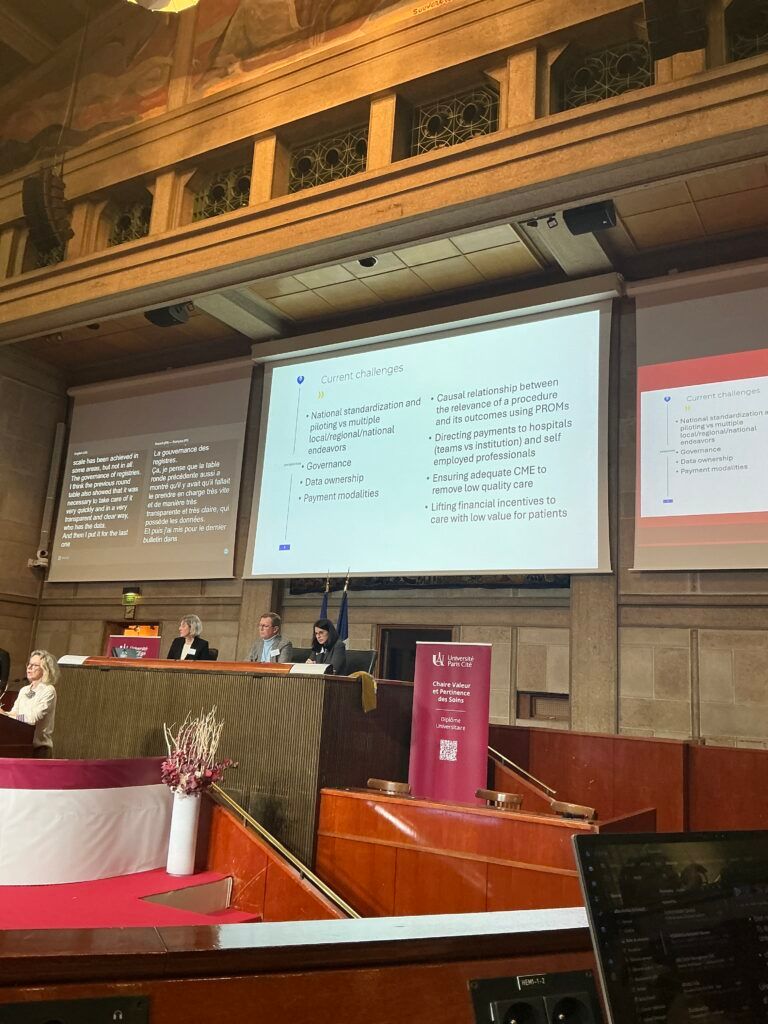
Hence the need for robust registry governance, ideally public, guaranteeing methodological rigour, equity and collective learning.
Comparing to improve: an international dynamic
Moderated by Mary Witkowski (Harvard Medical School), the session on international comparison of patient outcomes brought together Prof. Willem Jan Bos (Santeon hospital group), Alexandra Schmidt (Value Transformation Director, Air Liquide Healthcare), Bente Jorsma (Dutch Institute for Clinical Auditing) and Tania Aydenian (Takeda).
A strong message emerged:
benchmarking is not a ranking tool, but an engine for collective learning.
It is by comparing, understanding the differences and sharing practices that organisations genuinely improve.
Payment, incentives and behavioural economics: aligning funding and value
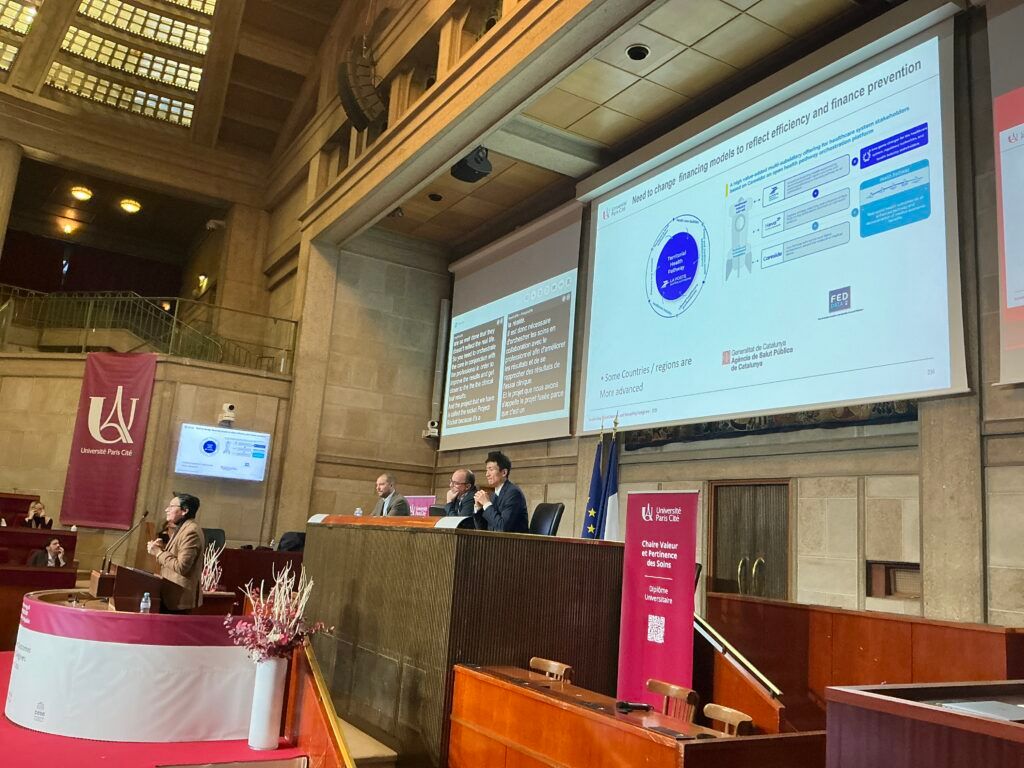
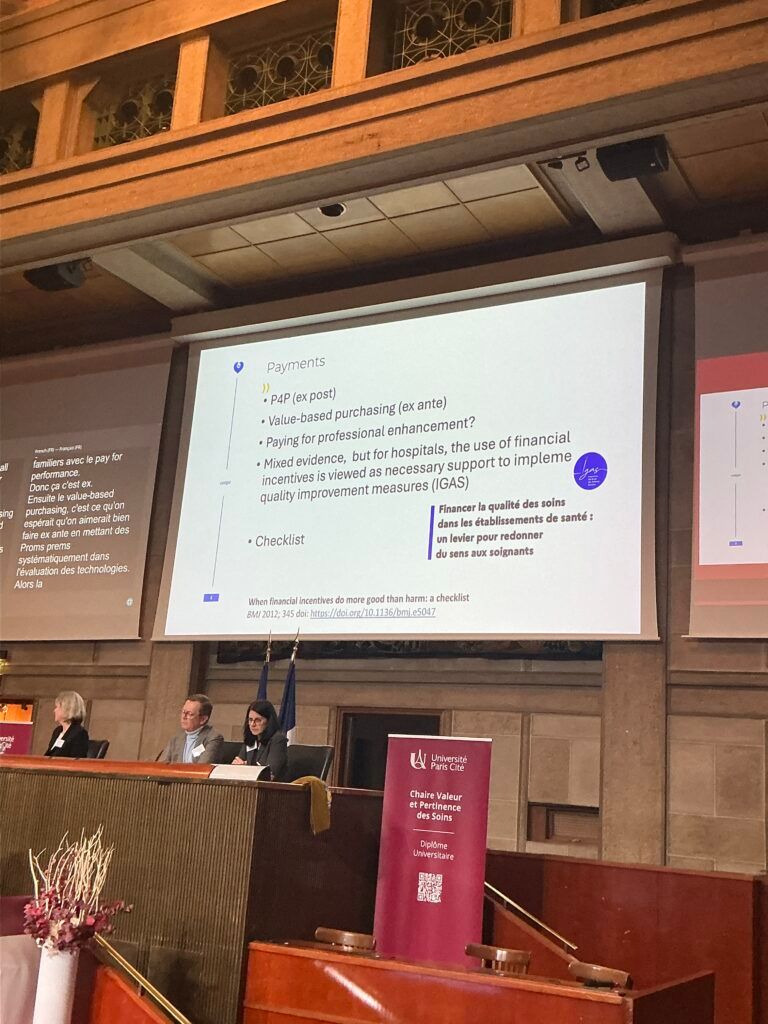
The session on PROM-adjusted payments, chaired by Prof. Susanna Gallani (Harvard Business School), with Prof. Isabelle Durand-Zaleski (Université Paris Cité, AP-HP), Prof. Sally Lewis (Swansea University, former VBHC director, NHS Wales) and Danny Hayventh (European Health Public Hospital Procurement Alliance), highlighted a key principle:
What gets paid for becomes the priority.
Financial incentives directly influence clinical behaviour, but they also produce unintended effects. Moving from fee-for-service to capitation or value-based payment models therefore requires a profound transformation of care pathways, governance and population health management.
Valuing outcomes and governance: the collective challenge
The session on valuing patient outcomes, moderated by Prof. Zirui Song (Harvard Medical School), with Dr Matthew Hickey (The Health Value Alliance), Roy Heusgen (AstraZeneca), Florence Dupré (La Poste Santé Autonomie) and Dr Grégoire Rangué (France PCI), underlined the importance of creating shared frameworks for assessing performance, involving regulators, funders and healthcare organisations.
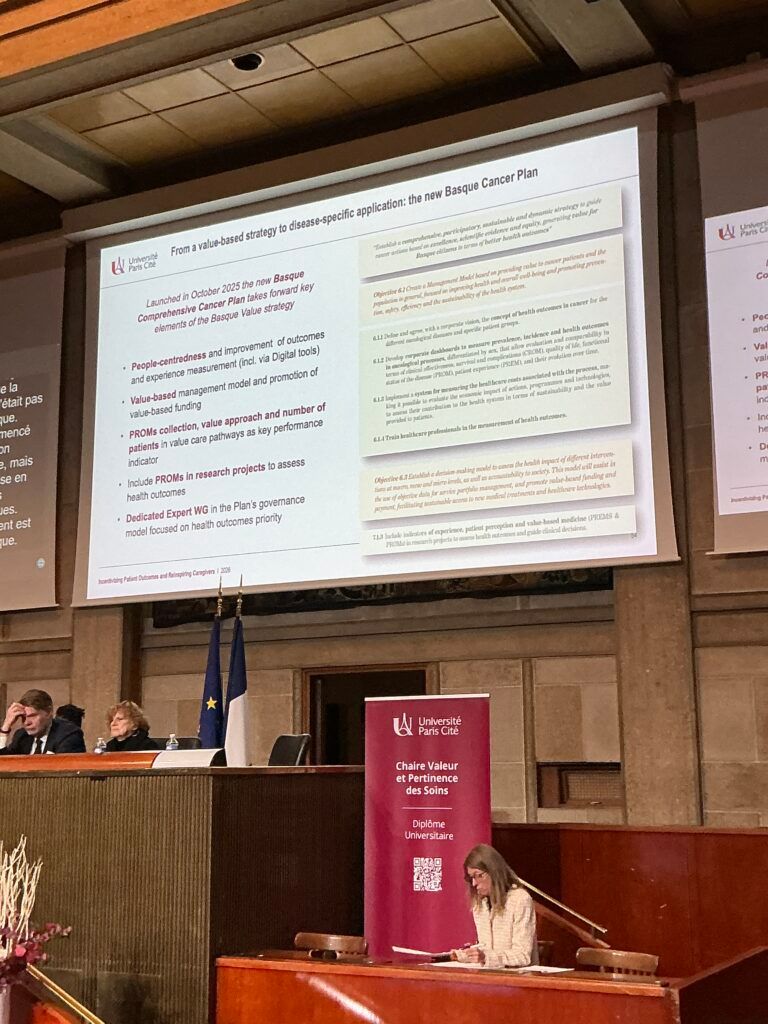
The discussions converged on the need to go beyond a purely metrics-based approach and build genuine value-based management models that integrate quality, equity, patient experience and economic sustainability.
A strong dynamic… but still unevenly legible
This congress undeniably reflects a rich, mature and structured dynamic. The concepts are settled, the scientific evidence is solid, and the tools are taking shape.
Yet an outside view of these discussions reveals a subtler tension: VBHC can still be hard to grasp for those discovering it.
Highly focused on PROMs, heavily tool-based and very conceptual, the discourse can give the impression of a movement still under construction, in which the concrete paths to transformation remain only partly visible. Detailed experience reports, intermediate steps, failures and day-to-day trade-offs are still rarely shared publicly.
Yet it is precisely these dimensions that allow organisations to picture themselves in the process, to understand how to move from intention to action, and to dare to take the first step.
In conclusion
The CESE congress marks a defining milestone in the trajectory of VBHC in France and in Europe. It confirms the growing maturity of the movement and the solidity of its scientific, clinical and economic foundations.
But it is also a reminder that the real battle is now being fought elsewhere:
in implementation engineering, operational governance and the ability to document what happens on the ground.
It is probably in this interplay between systemic vision and on-the-ground pragmatism that the next phase of Value-Based Healthcare will be built.
Screenshot
By Maria-Belen