Understanding Value-Based Procurement (VBP): the example of surgical gloves
How can a product that is cheaper to buy end up costing a healthcare organisation more? Take the example of a hospital that buys thousands of pairs of surgical gloves every year. Gloves are essential to the delivery of care. They are used in large quantities and are often regarded as products…
How can a product that is cheaper to buy end up costing a healthcare organisation more?
Take the example of a hospital that buys thousands of pairs of surgical gloves every year.
Gloves are essential to the delivery of care. They are used in large quantities and are often regarded as relatively interchangeable products.
Traditionally, the purchasing decision rests largely on one question:
“Which supplier offers the gloves at the lowest price?”
But what happens if the cheapest gloves generate additional costs for the hospital, while increasing the risks for patients and healthcare professionals?
This is precisely what Value-Based Procurement (VBP), or value-based purchasing, seeks to take into account.
1. The traditional approach: buying at the lowest price
Imagine two suppliers offering surgical gloves.
| Supplier A | Supplier B | |
|---|---|---|
| Price per pair | €0.20 | €0.30 |
| Quality | Lower reliability | Higher reliability |
| Price-based decision | The cheapest | The most expensive |
Fictitious prices and characteristics, used for teaching purposes.
If the hospital buys 100,000 pairs of gloves a year, choosing supplier A saves €10,000 on the purchasing budget.
From a traditional purchasing perspective, supplier A therefore seems the obvious choice.
But the purchase price represents only part of the real cost.
2. What happens when we look beyond the purchase price?
The quality of surgical gloves can have consequences across several dimensions of care.

1. Healthcare professionals’ productivity
Poor-quality gloves can tear more often. Professionals then have to interrupt their work, change gloves and sometimes repeat certain procedures.
Consequence: additional working time and higher operating costs.

2. Use of operating theatres
Latex proteins can contaminate the operating theatre environment. When a patient who is allergic to latex needs surgery, a complete new preparation of the room may become necessary.
Consequence: delays, additional preparation costs and reduced operating theatre capacity.

3. Patient safety
Micro-perforations in gloves can compromise the protective barrier and potentially increase the risk of surgical site infections.
Consequence: complications, additional treatment, longer hospital stays and poorer health outcomes.

4. Healthcare professionals’ safety
Defective gloves can increase the risk of exposure to bloodborne pathogens.
Consequence: additional occupational risks and potential costs linked to managing accidental exposures.
The original text cites two figures that illustrate the economic significance of these complications:
Surgical site infections
Up to €30,000
In additional medical costs per infected patient, compared with a non-infected patient.
Needlestick and sharps injuries
Up to $1,691
In costs per incident involving a healthcare professional.
These figures come from the studies cited in the book extract. They illustrate the potential economic consequences of complications and accidents, but do not correspond to costs directly attributable to glove quality.
3. The VBP approach: changing perspective
Rather than simply asking which gloves are the cheapest, the hospital asks a different question:
“Which gloves contribute to the best health outcomes, the safety of professionals and the efficiency of care, given their total cost?”
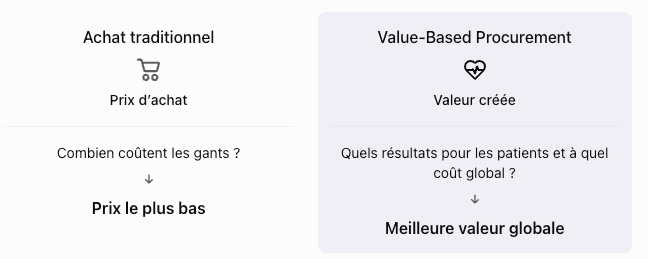
This approach requires buyers, healthcare professionals, quality managers, finance teams and suppliers to work together.
The aim is no longer just to negotiate a price, but to understand how the choice of a product influences the entire care process.
4. Let’s put figures on this example
Let’s go back to our two suppliers and imagine that supplier A’s less reliable gloves generate additional costs linked to interruptions in activity, working time and complications.
Interactive simulation: what is the real cost?
In this simulation, the choice that initially seemed the most economical can become the most expensive once the consequences for the organisation and the quality of care are taken into account.
This does not mean that a more expensive product is necessarily better. VBP specifically requires the additional value provided by the product to be demonstrated, not assumed.
5. What this example teaches us about VBP
Value-based purchasing is not about buying more expensive products. It is about making purchasing decisions by considering their contribution to health outcomes and their impact on the overall costs of care.
The surgical gloves example illustrates three fundamental principles:
1. The purchase price is not the total cost. A cheaper product can generate additional expenditure elsewhere in the care pathway.
2. Purchasing decisions can influence health outcomes. Product quality can have consequences for the safety of patients, the safety of professionals and the quality of care.
3. Value must be assessed beyond the procurement department. Buyers, clinicians, finance managers and suppliers must work together to identify, measure and improve this value.
So the question is no longer only:
“How much does this product cost?”
But:
“What value does this product help to create for patients, and at what overall cost?”
It is this change of perspective that forms the foundation of Value-Based Procurement.
What if you moved from theory to practice?
Value-Based Procurement is not just a new way of evaluating products. It involves rethinking collaboration between manufacturers, buyers and healthcare professionals around a shared goal: improving health outcomes while controlling the overall costs of care.
Are you a manufacturer or supplier of healthcare solutions?
How can you demonstrate the value of your products beyond their technical characteristics and their price? How can you build a value proposition based on measurable outcomes and open up a different kind of dialogue with your customers?
Are you a buyer or procurement manager?
How can you integrate health outcomes and overall costs into your selection criteria? How can you structure a value-based purchasing approach and evolve your contracting practices?
Do you want to set up value-based contracts?
How do you define the right indicators, share out responsibilities and build contractual models that align the interests of the different parties?
The Value Based HealthCare French Institute supports you, from training your teams to designing and implementing Value-Based Healthcare initiatives on the ground.
Let’s talk about your projects and challenges.
Sources
- Larsson S, Clawson J, Kellar J, Howard R. The Patient Priority: Solve Health Care’s Value Crisis by Measuring and Delivering Outcomes That Matter to Patients. Chapter 5, “Paying for Value Instead of Volume”. McGraw Hill; 2022. mheducation.com
- Badia JM, Casey AL, Petrosillo N, Hudson PM, Mitchell SA, Crosby C. Impact of surgical site infection on healthcare costs and patient outcomes: a systematic review in six European countries. Journal of Hospital Infection. 2017;96(1):1–15. https://doi.org/10.1016/j.jhin.2017.03.004 PubMed
- Mannocci A, De Carli G, Di Bari V, Saulle R, Unim B, Nicolotti N, Carbonari L, Puro V, La Torre G. How Much Do Needlestick Injuries Cost? A Systematic Review of the Economic Evaluations of Needlestick and Sharps Injuries Among Healthcare Personnel. Infection Control & Hospital Epidemiology. 2016;37(6):635–646. https://doi.org/10.1017/ice.2016.48 PMC
- Stanberry B, Bothma G, Harrison K. Using the MEAT VBP Framework to analyse and understand the value of surgical gloves: an explanatory case study. Health Economics Review. 2021;11. https://doi.org/10.1186/s13561-021-00325-z
Disclosure: I wrote this article with the help of AI ;)
By Maria-Belen