Building hospital pharmacists’ understanding of VBHC
A business school wanted an advanced VBHC module for hospital pharmacists: a tailor-made one-day course, from a conceptual framework to two original case studies.
1 day
of tailor-made training
2
original, reusable case studies
Contexte académique – Liban
Context
A business school specialising in training healthcare professionals wanted to offer an advanced module on Value-Based Health Care (VBHC) for hospital pharmacists.
The aim was not to introduce yet another theoretical concept, but to:
- make VBHC understandable and actionable for pharmacists
- anchor it in their day-to-day reality (medicines, devices, supply circuits, procurement, appropriate use)
- give them concrete tools to contribute to the value of patient journeys
The audience was made up of experienced pharmacists, already engaged in clinical, logistics or management roles within healthcare organisations.
Our approach
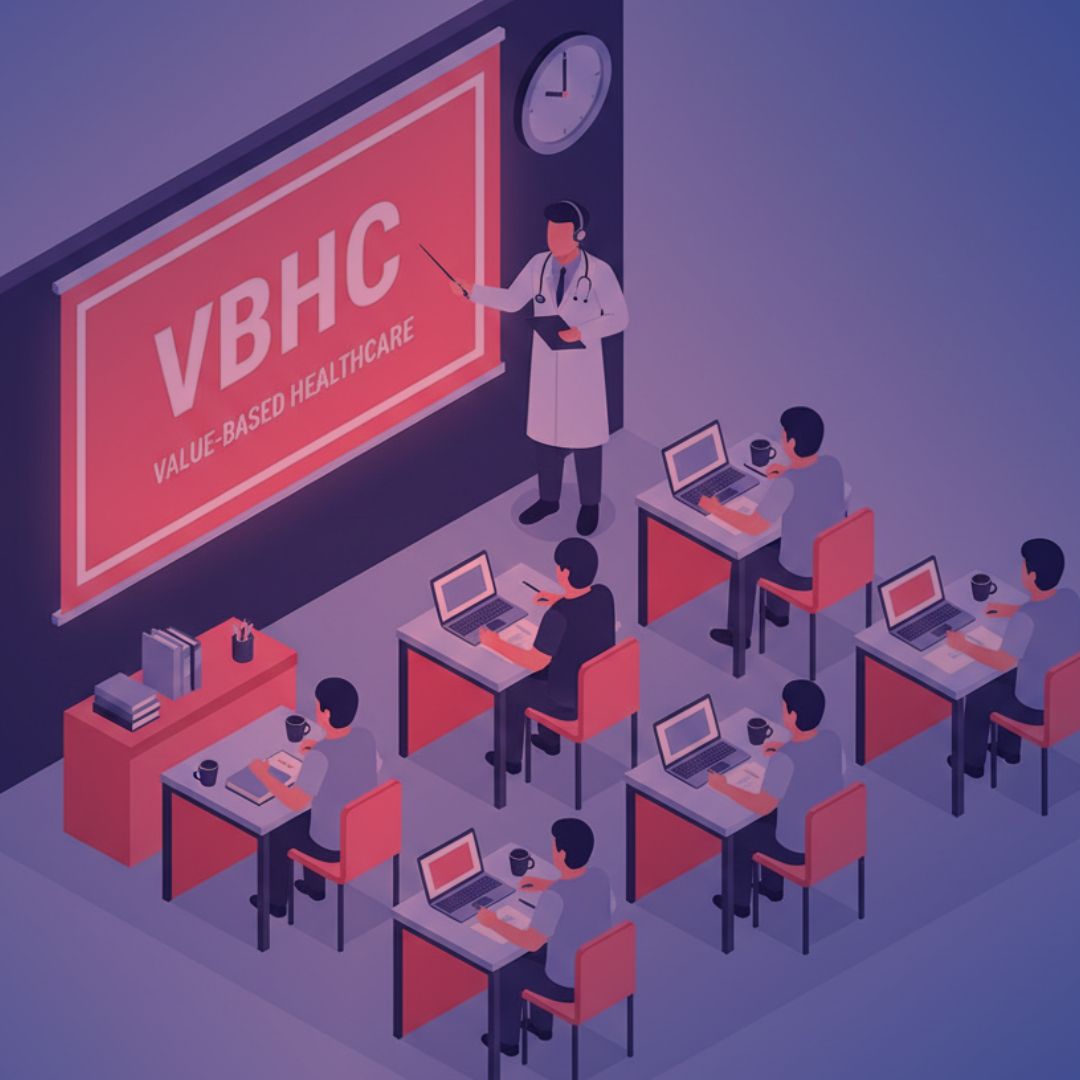
We designed and delivered a one-day training course, structured in two complementary parts.
1. Morning — A targeted conceptual framework
Rather than an academic presentation of VBHC, we worked on:
- the fundamental principles of VBHC translated for the role of the hospital pharmacist
- the place of medicines and medical devices in creating (or destroying) value
- the pharmacist’s specific levers for action in patient journeys (appropriateness, safety, coordination, avoided costs)
- the limitations of traditional indicators and the value of a reading focused on patient outcomes
The aim: to provide a clear framework, free of jargon, enabling participants to position themselves within a VBHC approach, even without a formal institutional project.
2. Afternoon — Case studies adapted to the field
We then designed two original case studies, specifically adapted to the reality of local hospital pharmacists.
These cases were not about finding a “right answer”, but about training participants to:
- read a patient journey through the lens of value
- identify where the medicine or device plays a structuring role
- analyse the tensions between quality, safety, organisation and costs
- formulate realistic improvement hypotheses, led by the pharmacist
The cases were worked on in small groups, then discussed collectively, with an emphasis on:
- the VBHC mindset
- the ability to make the case to doctors, management or buyers
- moving from intuition to a structured logic
What we delivered
- A tailor-made training course, adapted to the local context and to the hospital pharmacist’s profession
- Specific teaching materials, distinct from “generic” VBHC training
- Two original practical cases, designed to be reusable with other cohorts
- A visible increase in skills in reading patient journeys, the pharmacist’s contribution to value and the ability to engage with the other stakeholders in the system
Observed results
At the end of the training:
- participants expressed a better understanding of their strategic role in a VBHC approach
- VBHC came across not as an abstract model, but as a useful decision-making framework
- several participants identified concrete ways to develop their professional practice
A recurring piece of feedback was:
“This is the first time VBHC has spoken directly to our profession.”
Key learnings
- 01
VBHC becomes relevant when it is translated for each profession, not when it is presented as a universal model
- 02
Hospital pharmacists are key value stakeholders, provided they have a clear framework to express it
- 03
Contextualised case studies are a powerful lever for ownership
- 04
Training in VBHC is above all about developing mindset and reasoning skills, not passing on a reference framework
Would you like to train your teams or learners in VBHC in a way that is concrete and adapted to the reality of their profession?
We design tailor-made training courses and cases that turn understanding into the capacity to act.